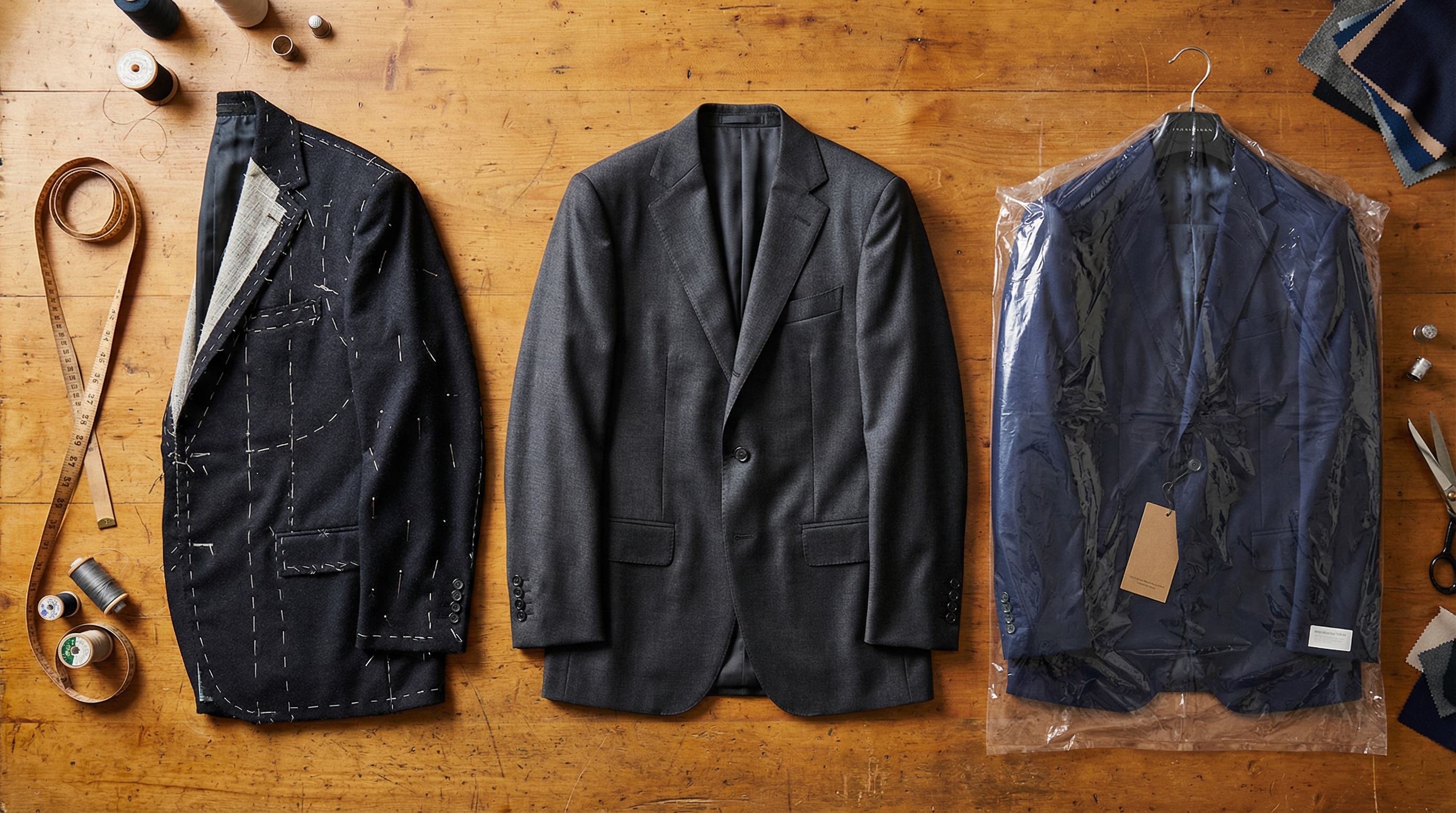
Your clients ask this question constantly. Here is the definitive breakdown — and when to recommend each one.
Every tailor has heard it: "What’s the difference between bespoke and made-to-measure?" It seems like a simple question. It isn’t. The terms are used loosely, often incorrectly, and the distinctions matter enormously — both for your clients’ expectations and for your business positioning.
Here’s the definitive guide you can reference (and share with clients who want to understand what they’re investing in).
Off-the-Rack: The Baseline
Off-the-rack (OTR) suits are pre-made in standard sizes and sold as-is or with minor alterations. They’re the benchmark against which custom work is measured.
How It Works
- Manufacturer cuts garments in standard sizes (38R, 40L, etc.)
- Customer tries on sizes and picks the closest fit
- Minor alterations — hemming trousers, taking in the waist — may be available
- Fabric, style, and construction are fixed by the manufacturer
Price range: $200–$2,000 depending on brand and fabric quality.
Best for: Clients with standard body proportions who need a suit quickly and at a lower price point. Also works as a starter suit for younger professionals building a wardrobe.
The catch: Fit is always a compromise. The suit was designed for an average body, and no two bodies are average in the same way.
Made-to-Measure: The Middle Ground
Made-to-measure (MTM) starts with an existing pattern and adjusts it based on the client’s measurements. Think of it as an off-the-rack suit that’s been customized before cutting.
How It Works
- Client’s measurements are taken (typically 15–20 points)
- A base pattern closest to the client’s size is selected
- The pattern is adjusted based on measurement deviations
- Client chooses from available fabrics, linings, buttons, and style details
- The suit is cut and assembled (often at a factory, sometimes with hand finishing)
Price range: $800–$3,000 depending on brand, fabric, and customization level.
Best for: Clients who want better fit than OTR and some personalization, but don’t need (or want to pay for) a fully bespoke garment. MTM offers the best value for most professionals.
The catch: Pattern adjustments have limits. If a client’s body deviates significantly from the base pattern — one shoulder higher, unusual posture, atypical proportions — MTM may not fully solve the fit problem.
Bespoke: The Highest Expression
Bespoke means the pattern is created from scratch for the individual client. No base pattern, no template — just the tailor’s skill applied directly to the client’s unique body.
How It Works
- Extensive measurements (40+ points, plus posture and movement observation)
- A unique paper pattern is drafted for the client
- A toile (test garment in muslin) may be created to verify fit
- Multiple fittings — typically 2–3 minimum — refine the garment on the body
- Hand construction: hand-sewn buttonholes, hand-padded canvas, hand-stitched seams
- The client’s pattern is stored for future orders
Price range: $3,000–$15,000+ depending on the tailor, fabric, and complexity.
Best for: Clients who demand perfection: exact fit for their body, total control over every detail, and the knowledge that no one else has the same garment. Also essential for clients whose bodies don’t conform to standard patterns.
The catch: Time and cost. A bespoke suit takes 6–12 weeks minimum, requires multiple in-person visits, and costs significantly more.
Side-by-Side Comparison
| Factor | Off-the-Rack | Made-to-Measure | Bespoke |
|---|---|---|---|
| Pattern | Standard sizes | Adjusted base pattern | Created from scratch |
| Measurements | Try-on only | 15–20 points | 40+ points |
| Fittings | 0–1 | 1–2 | 2–4 |
| Timeline | Same day | 3–6 weeks | 6–12+ weeks |
| Fabric choices | Limited | Wide selection | Unlimited |
| Construction | Machine | Machine + some hand | Primarily hand |
| Price | $200–$2,000 | $800–$3,000 | $3,000–$15,000+ |
What Should You Recommend?
The honest answer depends on your client:
- First suit on a budget? A well-chosen OTR with smart alterations
- Professional wardrobe upgrade? Made-to-measure hits the sweet spot
- Special occasion or fit-critical? Bespoke delivers what nothing else can
- Unusual body proportions? Bespoke may be the only option that truly fits
The Visualization Gap
The hardest part of selling MTM and bespoke is that the suit doesn’t exist yet. With OTR, your client tries it on. With custom work, they’re committing to something they can only imagine.
This is where AI visualization changes the conversation. When a client can see themselves in the suit — with their chosen fabric, in their actual proportions — the path from consultation to commitment gets much shorter. No more "let me think about it" because they can’t picture what they’re buying.
The Bottom Line
Bespoke, MTM, and OTR aren’t good-better-best. They’re different tools for different situations. Understanding the distinctions helps you guide clients to the right choice — which builds trust and leads to better outcomes for everyone.